ted boren archives
Nielsen/Norman Group is offering a free report on Rich Internet Applications”. It’s from 2002 and most of the apps reviewed are Flash-based—but hey, it’s free :-) And most of the findings focus on the interaction itself, not the technology. Quick skim looks promising…
posted by
ted
on Monday, Dec 15, 2008
“The art of architecture is really the art of constraint. It’s the art of compromise in many ways. It’s not about a brilliant man or woman working in his or her studio and producing a design and then getting it built. It’s about negotiating a whole series of constraints or challenges, whether those have to do with budget or site or the community.”
Christopher Hawthorne, architecture critic, quoted in an interesting NPR piece on modern museum architecture. This reminded me about a great design discussion we had sometime last year about Bryan Lawson’s great book, How Designers Think. Negotiating that series of constraints and challenges is hard… but FUN! Rob mentioned this same concept as he worked with me on some map icons that needed to work well on widely varied map backgrounds in a 10X10 pixel space. (Thanks Rob!)
posted by
ted
on Saturday, Dec 13, 2008

Another great use of the video player designed by Chris and company: the annual First Presidency Christmas Devotional.
Designerly things to note: loved the opening shots of the lights on Temple Square; not in love with the title text, but oh well; and loved the family room “set” behind the podium, though the flickering fireplace got a little distracting at times. Finally, note that the broadcast site offers audio in 29 languages, and video in 4 languages. The Church’s committment to the international audience is nowhere more apparent than in its broadcasting efforts…
A nod to accessibility as well—if you’ve never watched anything in sign language before, check out the ASL version, through at least the first Mormon Tabernacle Choir number (“Once in Royal David’s City,” which incidentally was written by a member of the Church). I love watching musical performances in ASL…
posted by
ted
on Tuesday, Dec 09, 2008
“You have to tell [them] your job role twice, your
job title once, and the language you prefer to speak 3 times—all
in English.”
Jared Spool, dazed by the number of hoops needed to pass through just to get to see (not buy) a product catalog of branded merchandise for a major technology company. (From a re-print of a year-old post on sign-in mistakes to avoid.)
posted by
ted
on Tuesday, Dec 09, 2008

Funeral services for Elder Joseph B. Wirthlin, of the Quorum of the Twelve Apostles, available in the new media player designed by Gilbert and company, which seems particularly well–suited to the dignity and solemnity of the occassion…
posted by
ted
on Friday, Dec 05, 2008
“It takes a strong
UX practitioner to stand up to an ill-informed team who think that Agile is about
speed rather than about better project control, and who subsequently think that user
experience work is a waste of time.”
Looking forward to reading the rest of Nielsen/Norman’s Best Practices for User Experience on Agile Development Projects
posted by
ted
on Monday, Dec 01, 2008
“Creativity is allowing yourself to make mistakes. Art is knowing which ones to keep.”
Scott Adams, The Dilbert Principle. There’s something about this that resonates… even though I’d like to think that not all good ideas start as mistakes…
posted by
ted
on Saturday, Nov 29, 2008
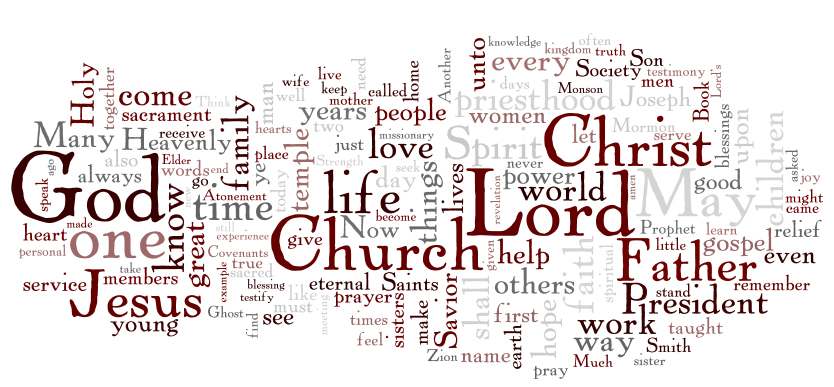
Wordle for last October’s General Conference, via Larry Richman. Nice job—love the font and color choices!
Clarification: Connor Boyack is actually the one who created this arrangement, using Wordle. See the comments for more info.
posted by
ted
on Tuesday, Nov 25, 2008
“When we misuse authority by preventing failure, we diminish accountability and capacity for learning.”
Barbara Tanner from George Wythe University . The context was in education, but I think it applies to allowing teams and individuals to take risks in the workplace as well. This made me think back to Scott Berkun’s session on spectacular design failures at UIE 13, as well as his essay on learning from mistakes. If we are so afraid of failure that we risk nothing, then we don’t grow.
posted by
ted
on Monday, Nov 24, 2008

Path leading up to a grove of trees adjacent to the Smith Family Farm near Palmyra, New York, where Joseph Smith’s first vision occurred. Very quiet, very peaceful, very inspiring on multiple levels. A few days prior, at the UIE 13 Conference, Luke W encouraged us to use color combinations we found in nature. After leaving the grove, I told my wife that I had found a color palette I wanted to use someplace in my work here at the Church. Now I just need to find the opportunity…
posted by
ted
on Thursday, Nov 20, 2008
Jared Spool just posted an interesting article on the ideal makeup of a UX team . He makes a useful distinction between a specialist and a compartmentalist:
While the former is about having the majority of your experience in a single discipline, the latter is about only having experience in that discipline… . A compartmentalist isolates themselves from the other disciplines around them, not really learning what they do or how they do it. Compartmentalism is bad for teams, because it means you have to have enough work to keep that individual busy within that discipline, and if needs shift or emergencies crop up, their value is dramatically diminished.
I would also add that a compartmentalist tends to make decisions that cause problems for other team members—the compartmentalized user researcher makes design recommendations that don’t meet the needs the business analyst identified previously; the designer designs something that will take $5 million to implement; the HTML coder who transforms those ultra-accessible semantic forms into screen-reader nightmares for the blind.
So I agree with Spool that compartmentalism is bad. But he also says that the main reason to choose a specialist over a generalist is economic; if a specialist is available and affordable, you would hire a specialist, according to the article. But aren’t there times when specialization is a negative for the project? Even if I could afford a specialist HTML coder, business analyst, interaction designer, and user researcher… isn’t there some inherent value in having the same person play one or more of those roles, depending on project size, complexity, or a host of other factors?
I don’t think economics is the only factor.
posted by
ted
on Monday, Nov 17, 2008
“Leaders inspire. Managers require.”
A participant at the George Wythe University Statesmanship Retreat last weekend, commenting on the difference between leadership and management. Not to say that good managers can’t also inspire—but when they do, that is when they Lead instead of merely Manage. Also, you can lead without being a manager—something good designers do every day.
posted by
ted
on Monday, Nov 17, 2008
“For now, we should just be happy that Windows 7 appears to be on the right track. You can almost look at consumer-level Windows—that is, 95, 98, Me, XP, Vista and Win 7—like the first six Star Trek movies: They pretty reliably alternate between crap and quality.”
Summarizing paragraph of the review of Windows 7 by Gizmodo. As soon as they brought up the Star Trek movies I knew just where they were going. Does that make me a geek, or does that make it a great analogy? Anyway, I use Windows at home, and am simply looking forward to an OS that gets out of my way. Hopefully they can deliver this time.
posted by
ted
on Tuesday, Nov 04, 2008

OK, so not everything on leaveyourprint.com is a nice as this banner, but it’s a big improvement on a lot of Utah government sites I’ve seen. Get involved in designing your government!
posted by
ted
on Monday, Nov 03, 2008
“Great rock stars would be lousy designers, lacking the discipline and respect that is needed to accomplish effective communication. I still have absolutely no idea what Kurt Cobain was trying to convey, specifically.”
Nathan Ford, decrying the use of “rockstar” to describe a top-notch designer. Instead, he suggests that a “master composer” is the better musical analogy.
posted by
ted
on Thursday, Oct 23, 2008

View of the historic Charles River from the conference hotel for UIE 13 in Boston last week.
Now that we are back from the conference, I’m faced with the usual dillemma of how to apply everything we managed to sip from the firehose of information and ideas… To make it easier, I took two sets of notes at the conference—one with specific ideas I thought I could apply short-term to my current projects, and another with more general insights I would need to mull over.
How about you? Any thoughts about making a reality out of conference pie-in-the-sky?
posted by
ted
on Tuesday, Oct 21, 2008
“If people don’t see it, make it bigger.
If you can’t make it any bigger, make it bold.
If you can’t make it any bolder, make it red.”
Tongue in cheek, Luke W paraphrasing the design mantra of those who don’t know how to really implement a visual hierarchy, today at UIE 13 . How many of you out there have heard those actual words? More than I’d like to think…
posted by
ted
on Monday, Oct 13, 2008
“The brand is what you tell your friends about afterwards.”
Mark Hurst of Good Experience, in one of the most concise and useful definitions of “branding” I think I’ve ever heard.
posted by
ted
on Wednesday, Oct 08, 2008
“We like looking five-years ahead because it gets beyond the
immediate reactive requirements and starts considering what a great
experience could be. If we only looked one year ahead, we’d be stuck with the current realities. If we look too far out, we get into the
realm of science fiction.”
Spool, explaining why one of the three key questions for experience design teams is whether they can articulate what the user experience will be in 5 years. Good article, if you’re in an introspective mood… I think me and my current team make the grade on 2 of the 3 questions… How ‘bout you?
posted by
ted
on Tuesday, Oct 07, 2008

(Top) The view from my house between General Conference sessions.
(Bottom) The view in the evening, after Conference was over.
Though not as spectacular to me as last year’s sun breaking through the clouds on the mountain on conference morning, I still like this pair of images. The cloud descends upon the mountain, the prophets deliver God’s message, and then after the cloud leaves, something has distilled on the mountain to sustain us for a little while, till the next time.
Thanks to Gilbert, Chris, and company for improving the online conference experience, by the way.
posted by
ted
on Monday, Oct 06, 2008